Solar for rural and commercial properties isn't the same as residential
Rural and large scale solar projects require a very different approach to standard residential systems.
On farms, stations and large lifestyle blocks, electricity demand is often tied to specific equipment (pumps, irrigation, processing), concentrated during daylight hours, and significantly higher than typical household use.
This makes solar particularly effective when systems are designed around load, not roof space.
Higher demand
Pumps, irrigation, and processing equipment require significantly more power
Daylight operation
Load concentrated when solar generation is strongest
Specialised equipment
Systems designed around specific operational requirements
"How do I know what size
system I need?"
There is no ‘standard’ system size that works for every home. We review:
Recent power bills
Household usage patterns
Heating systems
EV charging (current or planned)
Roof orientation, shading and space
"Should I install a battery?"
A battery allows you to store solar energy generated during the day and use it in the evening or overnight — rather than exporting it to the grid at a lower rate and buying it back later at a higher one.
Whether a battery makes sense depends on several factors:
Your evening and overnight energy use
How much you currently export to the grid
The buy-back rates available from your retailer
Your interest in backup power during outages
Future plans (e.g. adding an EV)
Our approach
We model your usage data, export patterns and retailer pricing to show whether a battery is cost-effective for your household — and if so, what size makes sense.
If it doesn’t make financial sense now, we design your system so a battery can be added later when circumstances change.
How residential solar works —
in simple terms
Daytime
Solar panels generate electricity when the sun shines. This power is used first by your home to run appliances, heating, and other loads.
Evening & Night
At night, your home draws from stored battery power (if available) or pulls from the grid as usual. The system switches seamlessly.
Storage or Export
Any excess power is either stored in a battery (if installed) or exported to the grid. You receive a buy-back credit for exported energy.
Our residential design approach
Every Southern Solar residential solar project starts with analysis, not assumptions.
Site-specific engineering
Every roof is different. We review orientation, shading, structural suitability and electrical infrastructure before recommending anything.
Energy modeling
We analyse your actual usage data to size the system correctly to prepare a full design and quote outlining expected performance, savings and ROI.
Local experience
We’ve installed solar systems across Central Otago, Wānaka and Queenstown, and understand the conditions, building styles and the requirements of councils and energy generators.
"
Southern Solar didn’t just install panels — they redesigned our entire electrical setup to work with solar and our EV charger. The attention to detail was exceptional.
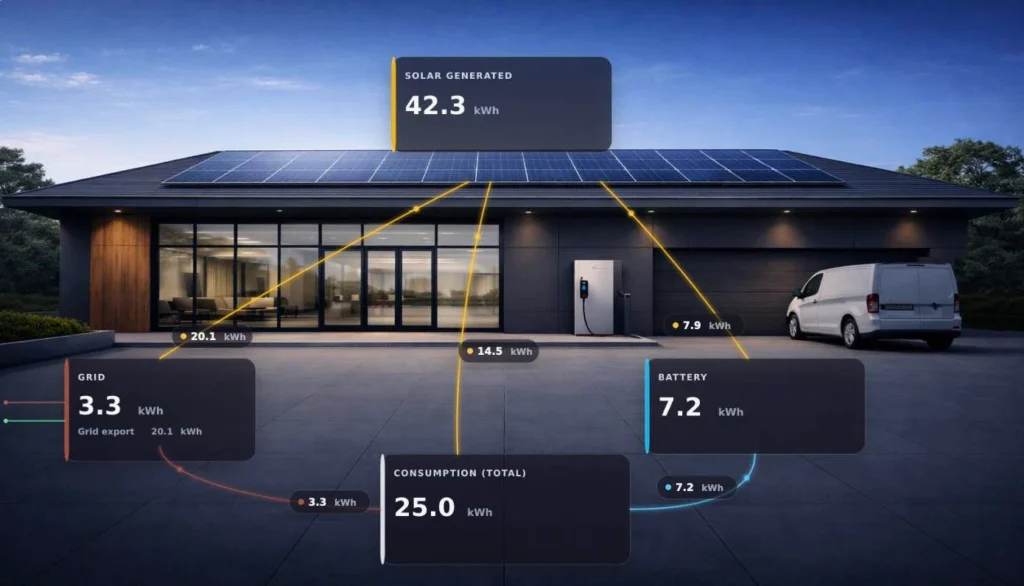
Once your system is live, you’ll have full visibility into how it’s performing through a clean, intuitive monitoring dashboard.
You can see in real-time:
How much energy your panels are generating
How much power your home is using
How much you're exporting to the grid
Battery charge levels (if installed)
Historical performance and trends
We also provide ongoing support to help you understand your data and optimise usage patterns — especially in the first few months as you adjust to solar.
Technology that performs in southern conditions
We don’t use off-the-shelf packages. Every component in your system — from solar panels to inverters, batteries and energy management — is carefully selected for proven performance in New Zealand’s demanding environments.
Whether it’s heavy snow loading in Central Otago, extreme winter cold, or coastal conditions, we specify products that are built to last and continue delivering energy long into the future.
Many major New Zealand banks offer “green” home loan top-ups which cover the installation of home solar. Banks require a quote or proposal from a SEANZ-certified authorised provider for solar panels and batteries.
These green loans typically offer competitive interest rates, making large-scale solar more affordable for rural and commercial operations. As a SEANZ-certified installer, Southern Solar can provide the documentation needed for your financing application.
Answers to frequently asked questions about commercial and farm solar
office@southernsolar.co.nz
Is solar reliable enough for farming operations?
Yes — when designed correctly. Solar systems for rural use are designed around critical loads, not assumptions. We assess when power is needed, what equipment draws the most load, and seasonal demand patterns. Systems can be designed to prioritise key circuits and integrate with existing infrastructure.
What about winter and variable conditions?
Winter output is lower, but rural demand is often lower at the same time. We model generation across seasons and design systems that deliver strong performance during high use periods — particularly spring and summer, when irrigation and pumping demand is highest.
Is a ground mounted system better than roof mounted?
In many rural situations, yes. Ground mounted systems allow optimal orientation and tilt, easier maintenance access, scalability over time, and better performance where roof space is limited or unsuitable. We assess each site individually and recommend the most practical configuration.
How is system sizing determined for farms?
Our team reviews your daily and seasonal load profiles, key equipment (pumps, sheds, pivots), and future plans. We don’t recommend standardised packages — instead, we custom size your system around actual farm data for maximum ROI.
Can solar work with diesel generators or batteries?
Absolutely — we design hybrid systems that integrate solar with your existing generation and backup systems, maximising reliability and flexibility. This is particularly valuable for remote operations or sites with critical loads.
What happens if the network goes down?
We can include backup capability with battery storage. We’ll advise you on the best approach for critical loads and network disruptions. For operations that can’t afford downtime, we design systems with islanding capability.
What support and service exists after install?
From modelling and installation to ongoing monitoring and technical support, we remain your single point of contact throughout your system’s life. We offer remote monitoring packages and responsive service for rural properties.
How do you handle network approvals for large rural projects?
We manage the entire approvals process including utility coordination and network compliance. Our experience with rural installations means we understand the specific requirements and can navigate them efficiently on your behalf.
Complete the form, send an email to office@southernsolar.co.nz or phone 021 70 30 62 to start your solar assessment
office@southernsolar.co.nz
Why solar makes sense for rural Central Otago
strong sunlight, dry
conditions,
Central Otago’s climate is well suited to solar generation:
and wide open sites suitable for ground mounted arrays.
At the same time, rural electricity costs continue to rise, and network infrastructure is under increasing strain as demand grows.
For many landowners, solar offers a way to:
Reduce ongoing electricity costs
Stabilise long term operating expenses
Generate power close to where it's used
Reduce exposure to network constraints
Solar doesn’t replace the grid — but it can significantly reduce reliance on it during peak demand periods.
Southern Solar is a SEANZ approved installer. SEANZ provides an authorised provider directory for members approved to supply and install solar systems for renewable energy loans provided by partner banks.